Frontend development is evolving faster than ever. Modern websites and applications are no longer built only for functionality — they are built for interaction, immersion, and user experience.
Today’s users expect interfaces to feel smooth, responsive, and dynamic across every interaction.
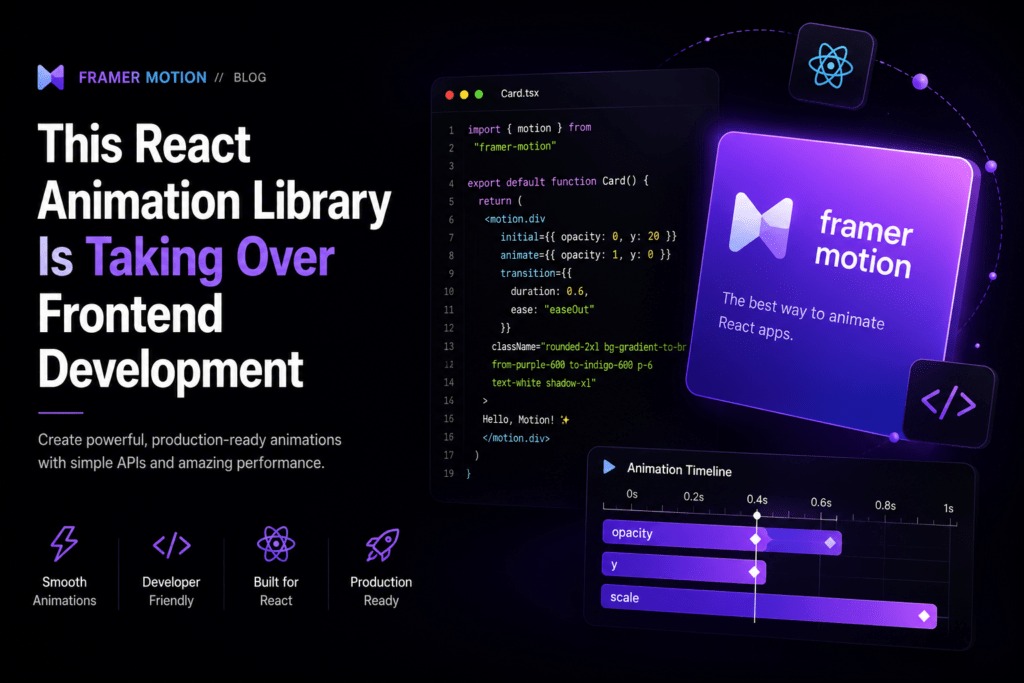
This is one of the biggest reasons Framer Motion is rapidly becoming one of the most important tools in modern React development.
From startup landing pages to enterprise dashboards and ecommerce platforms, Framer Motion is transforming how developers build frontend experiences.
Businesses investing in custom web development services are increasingly prioritizing motion-driven UI systems because frontend interaction quality now directly influences:
- User engagement
- Conversion rates
- Product perception
- Brand identity
Static interfaces are gradually disappearing from modern web ecosystems.
Why Frontend Development Is Becoming Motion-Driven
Traditional frontend systems focused mainly on:
- Layout rendering
- Responsive grids
- Basic transitions
- Static navigation systems
Modern frontend engineering now revolves around:
- Motion architecture
- Interaction systems
- Real-time UI feedback
- Dynamic component transitions
- Gesture-driven interfaces
- Experience engineering
Users today expect websites to respond naturally during every interaction.
Modern digital products are increasingly designed to feel:
- Fluid
- Interactive
- Responsive
- Cinematic
- Emotionally engaging
This is why businesses searching for responsive web development services increasingly expect advanced frontend experiences instead of traditional static websites.
Motion has become a core part of modern UI architecture.
Why Framer Motion Became So Popular
One major reason Framer Motion gained popularity so quickly is that it integrates perfectly with React’s component-based architecture.
Traditional animation libraries often feel disconnected from React because they manipulate the DOM externally.
Framer Motion works differently.
It allows developers to animate components directly inside React itself using declarative APIs.
This makes animation systems:
- Easier to scale
- Easier to maintain
- Cleaner architecturally
- More optimized for React rendering
Frontend developers can build highly interactive UI systems without creating complicated animation logic manually.
This significantly improves development efficiency for:
- SaaS applications
- Startup platforms
- Ecommerce systems
- Enterprise dashboards
Modern professional web development company teams increasingly rely on Framer Motion because it simplifies advanced frontend interaction engineering.
How Framer Motion Improves User Experience
Modern frontend development is heavily focused on usability and interaction psychology.
Animations improve user experience by creating:
- Visual continuity
- Navigation clarity
- Interaction feedback
- Spatial awareness
- Emotional engagement
Framer Motion enables developers to create:
- Smooth page transitions
- Shared layout animations
- Interactive navigation systems
- Gesture-based UI interactions
- Dynamic loading transitions
These systems make applications feel significantly more premium.
For businesses investing in business website development, smoother interactions improve how users perceive the brand digitally.
Users subconsciously associate responsive motion systems with:
- Higher quality
- Better technology
- Faster performance
- Improved trustworthiness
This psychological impact is one reason why modern frontend engineering now prioritizes motion architecture.
The Technical Advantage of Framer Motion
Framer Motion provides several technical advantages over traditional CSS-based animation systems.
It supports:
- Physics-based motion
- Shared layout transitions
- Gesture detection
- Scroll-linked interactions
- Component-level orchestration
- Runtime animation control
Unlike rigid CSS transitions, Framer Motion uses spring-based animation systems that create more natural movement behavior.
This allows interfaces to feel:
- More responsive
- More fluid
- Less robotic
- More immersive
Modern website development services in India providers increasingly implement these systems because frontend interaction quality directly impacts user retention.
Motion systems are becoming essential parts of scalable frontend architecture.
Performance Optimization in Modern Frontend Systems
Frontend performance is one of the biggest challenges in modern web development.
Poorly optimized animation systems often cause:
- Frame drops
- Scroll lag
- Repaint issues
- Main-thread blocking
- Layout thrashing
Framer Motion solves many of these issues through GPU-optimized rendering pipelines.
Modern frontend engineers primarily animate:
- transform
- opacity
- scale
- translate
- rotate
These properties are GPU composited, significantly improving rendering efficiency.
This is critical for responsive web development services because smooth performance across devices directly affects:
- SEO
- User experience
- Conversion performance
- Core Web Vitals
Modern users expect applications to remain fluid even during complex interactions.
Why Startups and SaaS Platforms Love Framer Motion
Many modern startups use Framer Motion because frontend experience has become a major competitive differentiator.
Modern SaaS applications increasingly depend on:
- Smooth onboarding systems
- Interactive dashboards
- Dynamic navigation
- Motion-driven interfaces
- Seamless transitions
Static interfaces often feel outdated compared to modern interaction-driven applications.
Businesses searching for the best website development company increasingly prioritize agencies capable of building:
- Interactive frontend systems
- Motion-first UI architecture
- Immersive digital experiences
This shift is heavily influencing startup product design globally.
Frontend engineering is no longer only about functionality.
It is about creating memorable user experiences.
Framer Motion and the Future of React Development
React development is rapidly evolving toward:
- Experience engineering
- Motion-first architecture
- Interactive UI systems
- Real-time frontend responsiveness
- Emotion-driven product design
Modern frontend systems now combine:
- React
- Framer Motion
- GSAP
- Three.js
- WebGL rendering pipelines
to create highly immersive web experiences.
Businesses investing in custom web development services increasingly expect websites and applications that:
- Feel responsive
- Move naturally
- Guide user attention
- Create interaction continuity
The future of frontend development is becoming increasingly motion-driven.
Why Motion Is Becoming Essential in Business Websites
Modern business websites are no longer simple information pages.
They are becoming interactive product experiences.
Motion systems improve:
- Engagement
- Retention
- Navigation clarity
- Conversion performance
- Brand perception
This is why companies searching for website development services in India increasingly demand:
- Dynamic interfaces
- Smooth transitions
- Interactive navigation
- High-performance frontend systems
The more responsive and fluid the website feels, the stronger the user connection becomes.
Conclusion
Framer Motion is taking over frontend development because it simplifies the creation of highly interactive, smooth, and performant UI systems inside React applications.
By combining:
- Declarative animation APIs
- Physics-based motion systems
- GPU-optimized rendering
- React-native architecture
- Advanced interaction control
Framer Motion enables developers to build interfaces that feel modern, immersive, and premium.
From responsive web development services to advanced business website development, motion-driven frontend architecture is becoming essential in modern digital experiences.
As businesses continue investing in premium interaction systems, frontend development is evolving from static interface building into experience engineering.
The future of React development is no longer static.
It moves, responds, and feels alive.