
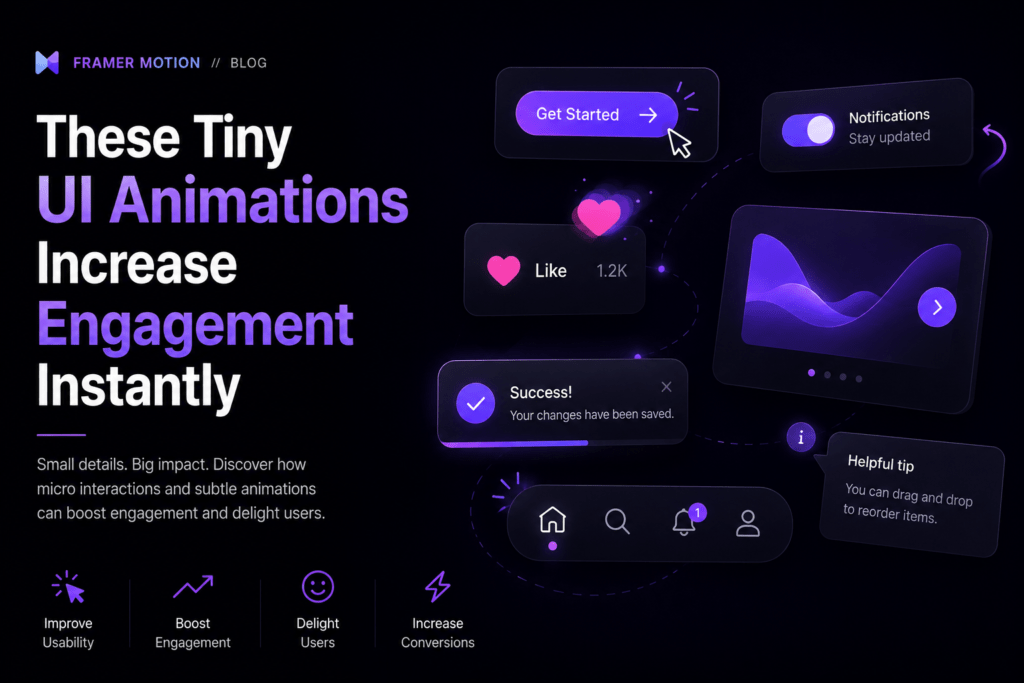
Modern websites are no longer competing only through design or functionality. Today, user engagement depends heavily on interaction quality.
The smallest UI animations can completely change how users experience a website.
A button slightly expands during hover. A smooth navigation transition. A product card reacting naturally to movement. A subtle loading animation during interaction.
These tiny motion details may seem minor technically, but psychologically they create a massive impact.
Modern frontend development is now heavily focused on microinteractions because users subconsciously respond to movement, feedback, and motion continuity during digital experiences.
Businesses investing in custom web development services are increasingly prioritizing interaction systems because static interfaces no longer create strong engagement.
Today’s users expect websites to feel responsive, fluid, and alive.
What Are UI Microinteractions?
Microinteractions are small animations or motion behaviors that respond to user actions.
They are designed to provide:
- Visual feedback
- Interaction clarity
- Navigation continuity
- Emotional engagement
- Better usability
These animations are typically triggered by:
- Hover states
- Button clicks
- Scroll behavior
- Form interactions
- Page transitions
- Navigation changes
Although subtle, these motion systems dramatically improve user experience.
Modern professional web development company teams increasingly use microinteractions to create smoother frontend experiences that feel more natural and intuitive.
Without interaction feedback, websites often feel disconnected and unresponsive.
Why Tiny Animations Have Massive Psychological Impact
The human brain naturally reacts to motion.
When interfaces respond dynamically to interaction, users perceive the system as:
- Faster
- More intelligent
- More premium
- More trustworthy
- More technologically advanced
This psychological effect is one reason modern websites from companies like Stripe, Apple, Framer, and Linear feel significantly more immersive than traditional websites.
Microinteractions create:
- Better visual flow
- Reduced cognitive friction
- Higher attention retention
- Stronger emotional engagement
For businesses investing in business website development, these systems improve how users emotionally connect with digital products.
The smoother the interaction feels, the better the overall perception of the brand.
The Technical Foundation Behind Modern UI Animations
Modern UI animations are built using advanced frontend animation systems such as:
- GSAP
- Framer Motion
- CSS GPU transforms
- requestAnimationFrame rendering pipelines
These technologies allow developers to create:
- Smooth hover interactions
- Dynamic component transitions
- Physics-based motion systems
- Real-time UI feedback
- Scroll-triggered interactions
Unlike traditional CSS transitions, modern animation systems focus heavily on:
- Frame consistency
- GPU acceleration
- Runtime optimization
- Motion continuity
- Interaction responsiveness
This is why companies searching for responsive web development services increasingly expect advanced frontend motion systems inside modern websites.
Why Microinteractions Improve User Engagement
Engagement is directly tied to how users experience interaction flow.
Tiny UI animations improve:
- User attention
- Interaction satisfaction
- Session duration
- Navigation flow
- Interface usability
For example:
- Buttons responding during hover increase click confidence
- Smooth navigation transitions improve user orientation
- Animated loading states reduce perceived waiting time
- Motion feedback improves interaction understanding
Modern website development services in India providers increasingly integrate microinteraction systems because frontend responsiveness now plays a major role in user retention.
Websites that feel interactive naturally encourage users to explore more content.
Microinteractions in Modern Business Websites
Today’s business websites are evolving into highly interactive digital experiences.
Businesses investing in custom web development services now expect:
- Motion-first UI systems
- Smooth transitions
- Dynamic scrolling behavior
- Real-time interaction feedback
- Premium frontend experiences
Microinteractions help business websites:
- Feel technologically advanced
- Improve first impressions
- Build stronger trust
- Increase interaction quality
- Create smoother navigation
This is one reason why many companies searching for the best website development company focus heavily on frontend interaction quality instead of only visual design.
Users remember how the website felt during interaction.
The Role of Motion in Responsive Web Development
Modern responsive web development services are no longer limited to layout responsiveness alone.
Frontend systems must now adapt interaction quality across:
- Desktop devices
- Tablets
- Smartphones
- High-refresh displays
- Touch interfaces
Microinteractions improve responsiveness by creating smoother transitions between user actions and interface reactions.
Modern frontend engineers optimize animations using GPU-friendly properties such as:
- transform
- opacity
- scale
- translate3d
This prevents:
- Layout thrashing
- Frame drops
- Scroll lag
- Main-thread blocking
As experienced frontend developers continue optimizing performance architecture, motion systems are becoming essential parts of responsive frontend engineering.
Why Premium Websites Use Motion Systems
Premium websites feel different because every interaction is carefully designed.
Modern frontend systems use motion to:
- Guide user attention
- Improve navigation flow
- Enhance storytelling
- Build emotional engagement
- Strengthen product perception
This is why companies investing in business website development increasingly prioritize:
- Motion architecture
- Interaction systems
- Scroll choreography
- Dynamic UI sequencing
Static websites often feel outdated because they lack interaction and continuity.
Modern users expect websites to respond naturally to every action.
The Rise of Experience-Driven Frontend Development
Frontend engineering is rapidly evolving toward:
- Experience design
- Motion architecture
- Interaction psychology
- Immersive UI systems
- Real-time responsiveness
Today’s users expect digital products to feel alive.
Businesses searching for website development services in India increasingly demand websites that:
- Feel fluid
- Respond instantly
- Interact naturally
- Guide attention smoothly
This shift is transforming how modern frontend systems are built.
Microinteractions are no longer optional enhancements.
They are becoming foundational parts of premium web experiences.
Why Businesses Are Investing in Motion-Driven UI
Digital competition is becoming increasingly experience-driven.
Users decide quickly whether a website feels:
- Premium
- Professional
- Modern
- Trustworthy
Tiny animations significantly influence this perception.
Businesses investing in custom web development services with advanced interaction systems often experience:
- Higher engagement rates
- Better conversion performance
- Improved user retention
- Stronger brand perception
- Better customer experience
This is why modern professional web development company teams increasingly focus on interaction engineering instead of only visual design implementation.
Conclusion
Tiny UI animations may appear small technically, but they create a massive impact on user engagement, perception, and frontend experience quality.
Modern motion systems powered by technologies like GSAP and Framer Motion are helping businesses create websites that feel:
- Responsive
- Interactive
- Smooth
- Immersive
- Premium
From responsive web development services to advanced business website development, microinteractions are becoming critical components of modern frontend architecture.
As businesses continue investing in experience-driven digital products, websites are evolving beyond static interfaces into highly interactive systems that users genuinely enjoy interacting with.
The most engaging websites today are not simply the ones that look good.
They are the ones that respond, move, and interact naturally with users.